

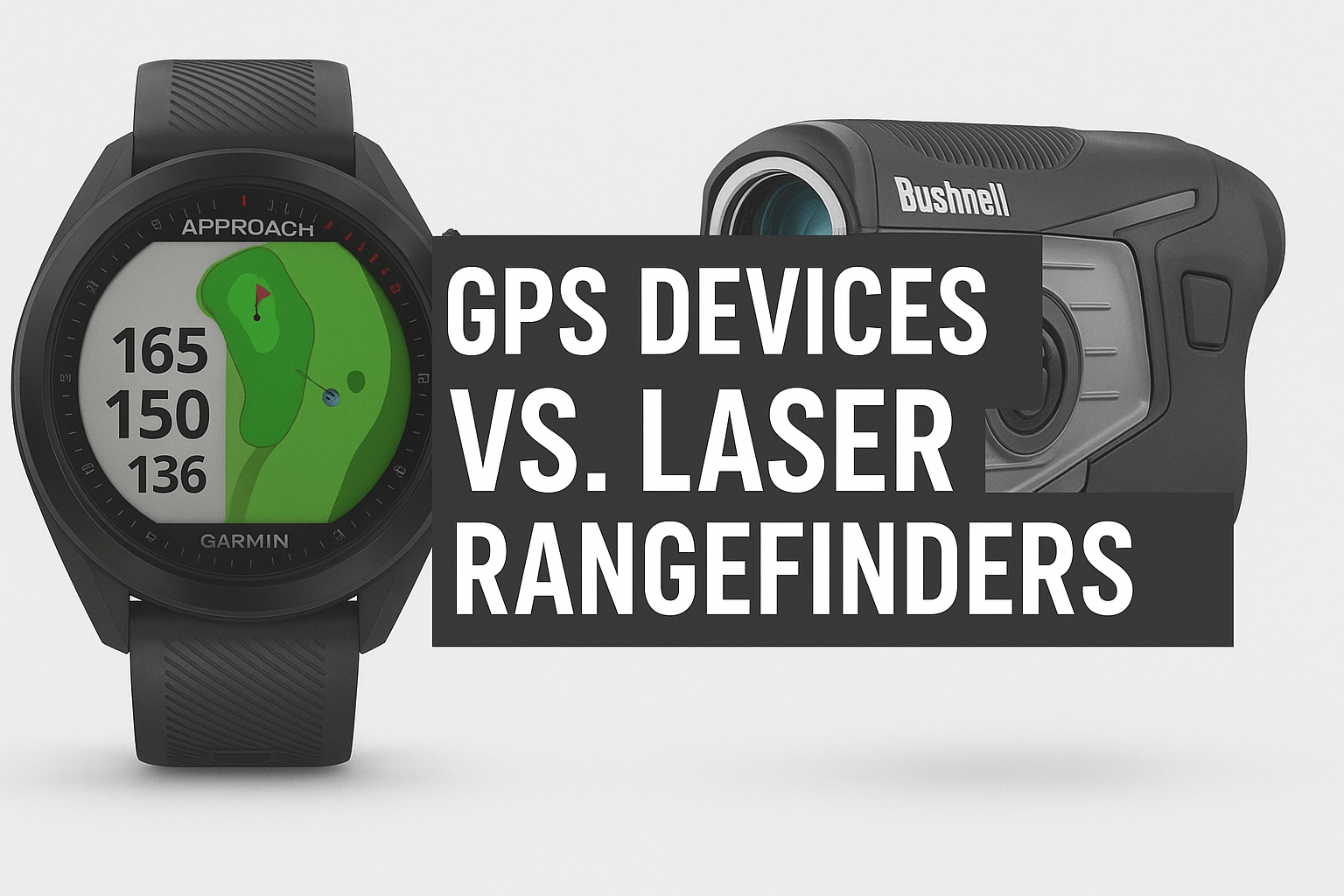
GPS devices and laser rangefinders serve different purposes, and each suits different types of golfers. Understanding the strengths of both, as well as their limitations, will help you choose the one that matches your playing style and priorities on the course.
GPS devices, such as Garmin golf watches and handhelds, give you a complete view of the hole and valuable course management tools. They offer:
Distances to the front, middle, and back of greens
Hazard locations and carry distances
Hole layouts and course maps
Shot tracking and performance statistics
Always-on convenience without extra setup
The drawback: GPS accuracy can fluctuate due to environmental conditions that affect satellite signal acquisition. Some devices are more accurate than others, but in rare cases you may see slight variations in yardages.
Laser rangefinders, led by trusted names like Bushnell, provide pinpoint accuracy for golfers who want exact distances to a visible target. They offer:
Precise distances to any target you can see
Pin-seeking technology for exact flagstick measurements
Superior accuracy (typically within 1 yard, compared to 3–5 yards for GPS)
No reliance on course mapping or updates
Tournament and Slope Functions
Most modern devices include two modes:
Tournament-legal mode: provides only straight-line distances
Slope-adjusted mode: factors in elevation changes for uphill and downhill shots
The slope function is not legal in tournament play but is extremely useful for practice rounds, helping you understand how elevation affects club selection.
The drawback: Rangefinders rely on line of sight. If you’re in the trees, behind a mound, or below the level of the green and can’t physically see the flag, the rangefinder won’t be able to give you a reading.
GPS devices work best for:
Golfers who want comprehensive course information
Players who like seeing hazards, layup points, and overall hole strategy
Those who prefer not to carry an extra device
Golfers who play multiple courses and value quick course mapping
Players focused on course management rather than pinpoint precision
Laser rangefinders are ideal for:
Golfers who prioritize pinpoint accuracy
Players with consistent pre-shot routines
Those who mainly need flag distances
Golfers who like picking out specific landmarks and targets
Players who don’t mind taking the extra step of ranging each shot
Many serious golfers use both, a GPS device for overall course awareness and hazard information, paired with a rangefinder for pinpoint accuracy. This combination delivers the best of both worlds but does come at twice the price...
GPS devices: Often provide better overall value, as many double as fitness trackers and smartwatches. Garmin’s golf GPS watches, for example, combine golf-specific data with everyday functionality.
Rangefinders: Can be cheaper, excluding the top of the range hybrid models. However, they only do one thing. Measure distance precisely. Brands like Bushnell are unmatched in accuracy and reliability, an advantage if precision is your top priority.
There’s no single “best” choice between GPS devices and laser rangefinders, it comes down to what's important for you.
If you value strategy, convenience, and a big-picture view of the course, a GPS device like those from Garmin may be perfect.
If you want exact yardages to the pin and prefer ultimate accuracy, a rangefinder is the way to go.
And for many golfers, the smartest solution is a hybrid setup: GPS for strategy, rangefinder for precision.





No comments yet. Be the first to comment!